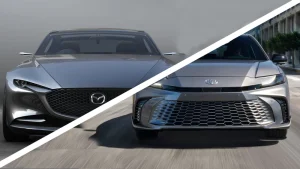
The partnership between Toyota and Mazda in developing sports cars is capturing attention in the automotive industry, particularly among garages in Vietnam. These two renowned Japanese brands, with a long-standing relationship, are reportedly collaborating to create new sports car models, promising both opportunities and challenges for garages aiming to stay ahead of trends. According to credible sources like Japan’s Best Car, this project not only aims to revive legendary names but also ushers in a new era for high-performance vehicles.
Toyota and Mazda: A Strong Strategic Partnership
Toyota and Mazda are no strangers to collaboration. Since signing a technology-sharing agreement in 2015, the two brands established the joint Mazda Toyota Manufacturing plant in the U.S. in 2021. Now, rumors of a shared sports car project are gaining traction. According to Best Car, Toyota may share development costs for the next-generation GR Supra with Mazda, while Mazda is expected to revive the iconic RX-7. A key highlight? The new RX-7 may ditch the traditional rotary engine in favor of Mazda’s turbocharged inline-six engine, already featured in CX-series SUVs.
For garages, this is positive news. Sports cars typically require specialized maintenance and performance upgrades, from suspension and brakes to engines. If the project comes to fruition, garages can anticipate a new wave of customers—speed enthusiasts eager to optimize their Toyota Supra or Mazda RX-7.
New Sports Cars Bring Opportunities for Garages
The project goes beyond reviving the RX-7. Toyota is reportedly continuing development of the GR Supra, currently a collaboration with BMW, but this time potentially infused with Mazda’s influence. Some sources suggest Mazda is also considering a four-door coupe, distinct from the two-door Supra, adding diversity to the sports car segment. This means garages will have access to a wider range of vehicles, from engine configurations and drivetrains to aerodynamic designs.
Sports cars are often a goldmine for tuning-focused garages. For instance, Mazda’s turbocharged inline-six engine, if used in the RX-7 or Supra, could deliver 350 to 400 horsepower. Services like turbo upgrades, ECU tuning, and exhaust system replacements are likely to become popular. Additionally, with the trend toward hybridization, garages must prepare to handle combined electric and combustion systems—a field requiring new equipment and skills.
Challenges and Preparation
However, opportunities come with challenges. Modern sports cars, especially those incorporating hybrid technology like Mazda’s Iconic SP concept, demand advanced diagnostic tools and technician training. High-voltage electrical systems, hybrid batteries, and complex control software cannot be managed with traditional tools. Smaller garages may struggle to compete with larger centers already equipped for new technologies.
Furthermore, if Toyota and Mazda target global markets, including Vietnam, garages must closely monitor technical specifications and parts availability. For example, the new RX-7 may use an enhanced Skyactiv-G engine, requiring access to genuine or compatible components, which may not always be readily available locally.
Conclusion
The collaboration between Toyota and Mazda in the sports car segment is a highly promising development, not only for consumers but also for garages. With the potential GR Supra and RX-7, garages have an opportunity to expand services, from basic maintenance to high-performance tuning. However, capitalizing on this requires investment in technology and skills. Vietnamese garages should start preparing now—because when these sports cars hit the roads, customers will seek out those ready to meet their demands!