Entering 2026, owning a car is no longer a novelty for Vietnamese consumers, but the topic of maintenance and repair costs remains as hot as ever. For any car owner, facing a repair estimate from a garage always brings about a degree of hesitation. Is this price reasonable? How can you avoid falling into the trap of “fabricated faults and price gouging” by untrustworthy establishments? This article will provide you with the most updated car repair price list, along with highly valuable, practical tips straight from the experts.
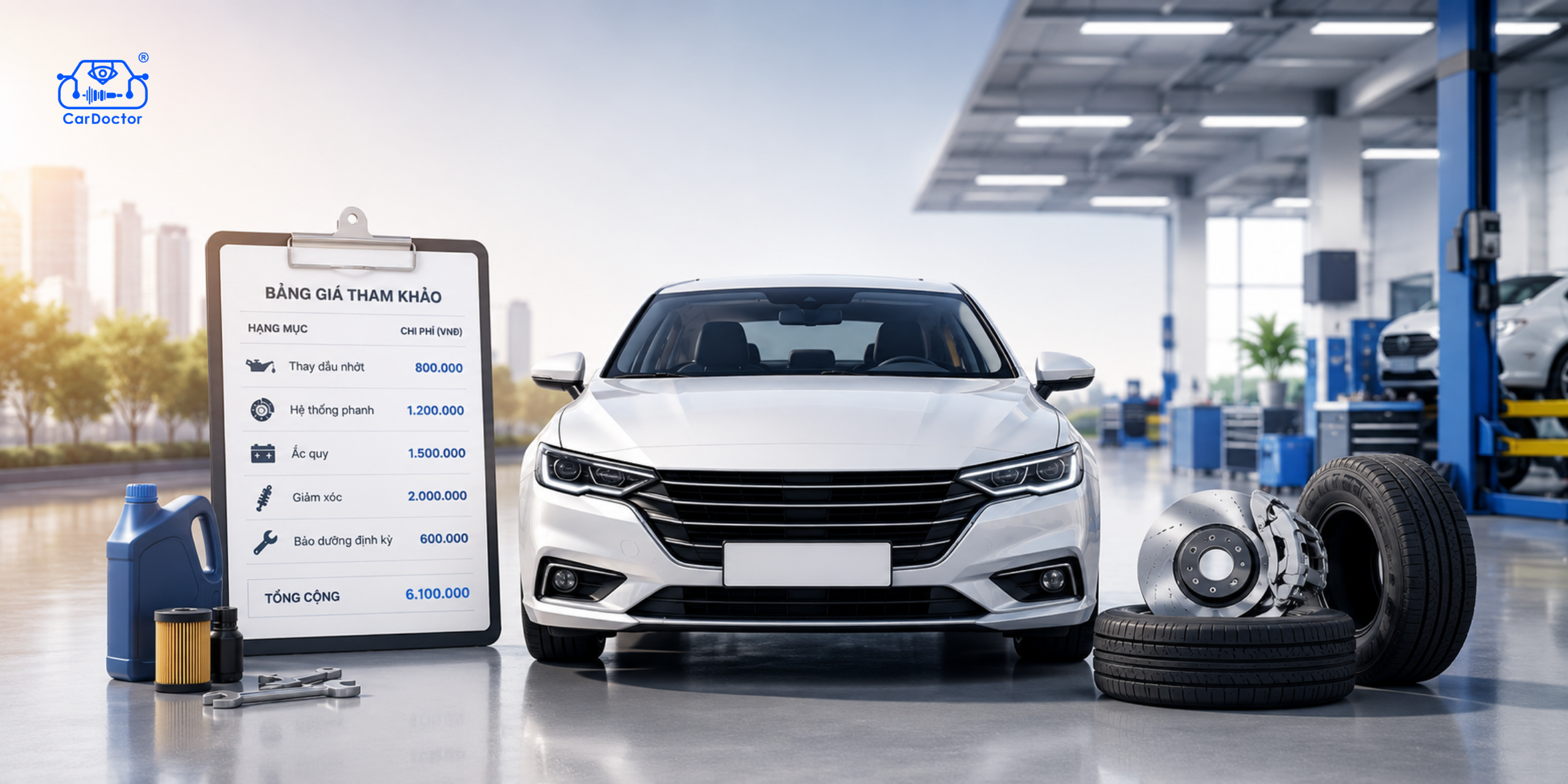
1. Detailed Car Repair Price List for Common Items
Actual repair costs depend heavily on the severity of the damage and the type of replacement parts used. Below is the average reference price range (including parts and labor) for routine repair and maintenance items at reputable garages today:
Routine Maintenance & Diagnostic Items
- Initial Inspection & Diagnostics: A comprehensive survey of the exterior, engine, brakes, suspension, electrical systems, etc. Prices range from 200,000 to 500,000 VND per inspection.
- Engine Oil & Filter Change: Replacing the oil filter and engine oil (approximately 4–6 liters depending on the vehicle). Reference price ranges from 600,000 to 1,200,000 VND.
- Filter Replacements: Engine air filter (replace every 15,000–20,000 km) and fuel filter (replace every 30,000–40,000 km). Prices are around 300,000 to 700,000 VND per filter.
Safety, Suspension & Drivetrain Systems
- Braking System: Inspecting brake pads, rotors, and pressure cylinders. Brake pad replacement ranges from 400,000 to 1,200,000 VND / wheel; brake rotor replacement ranges from 800,000 to 2,000,000 VND / axle.
- Suspension & Shock Absorbers: Shock absorber replacement ranges from 1,200,000 to 3,500,000 VND / wheel; coil spring replacement ranges from 800,000 to 2,200,000 VND / wheel.
- Cooling System: Coolant flush and replacement costs 200,000 to 400,000 VND; water pump replacement ranges from 1,500,000 to 3,000,000 VND.
- Drivetrain System: Clutch fluid replacement costs 500,000 to 1,200,000 VND; a complete clutch kit replacement fluctuates between 2,500,000 and 6,000,000 VND depending on the vehicle type.
Electrical System & Other Wear-and-Tear Parts
- Electrical System & ECU: Car battery replacement ranges from 800,000 to 2,500,000 VND; troubleshooting and repairing ECU (Engine Control Unit) faults ranges from 1,000,000 to 3,000,000 VND.
- Fast Wear-and-Tear Parts: Spark plug set costs 100,000 to 300,000 VND / set; accessory drive belt costs 200,000 to 600,000 VND; auxiliary sensors or wiring harnesses range from 300,000 to 1,500,000 VND.
- Auxiliary Services: Wheel balancing costs 80,000 to 150,000 VND / wheel; power steering system recalibration costs 300,000 to 800,000 VND; interior detailing and car wash range from 150,000 to 500,000 VND.
2. Cost Comparison Among Popular Car Brands
To give you a more visual breakdown of vehicle upkeep costs, below is a summary table of reference prices for 4 basic maintenance items across several common car brands:
| Car Brand | Oil Change (VND) | Air Filter Change (VND) | Brake Pad Replacement (4 Wheels) (VND) | Shock Absorber Replacement (4 Wheels) (VND) |
| Toyota | 800,000 | 350.000 | 1,200,000 | 3,000,000 |
| Honda | 750,000 | 300,000 | 1,100,000 | 2,800,000 |
| Ford | 900,000 | 400,000 | 1,300,000 | 3,200,000 |
| Mazda | 850,000 | 380,000 | 1,250,000 | 3,100,000 |
Note: The above price list is for reference purposes only under current market conditions. Actual costs may fluctuate depending on the location, time of repair, as well as specific technical requirements of each vehicle generation.
3. Core Factors Component to Car Repair Costs
Why do different cars have vastly different repair bills for the exact same mechanical issue? Technical experts point out several core factors that directly influence your final invoice:
- Car Brand & Origin: Imported vehicles usually involve more complex maintenance procedures and require genuine factory parts, driving up costs by 20% to 40% compared to locally assembled vehicles.
- Vehicle Age (Model Year): The older the vehicle, the more components degrade simultaneously. Repairing one part might reveal underlying failures in another related system, increasing unforeseen costs by 10% to 30%.
- Severity of Damage: Minor fixes at quick-service stations are always significantly cheaper than major mechanical issues that require dropping the engine or completely dismantling intricate systems (surging costs by 15% to 50%).
- Geographical Location: Due to overhead costs and higher labor rates, repairing a vehicle in major metropolitan centers and big cities is typically 5% to 15% more expensive than in rural provinces.
- Warranty Policies: If your vehicle is still under the manufacturer’s factory warranty and the failure stems from a technical defect, repair costs can be discounted by up to 100%.
4. Tips for Reading Estimates and Avoiding Being “Ripped Off” at Garages
To prevent yourself from becoming “easy prey” to price-gouging tactics, car owners should proactively apply the following verification and comparison rules before signing any repair orders:
- Clearly identify symptoms before heading to the shop: List out the exact anomalies you experience (e.g., “The engine vibrates heavily when accelerating from a stop,” “There is a squeaking noise when applying the brakes”). This keeps you from being misguided into replacing unrelated components.
- Apply the rule of price comparison: For major repair packages, never hesitate to request and collect a detailed itemized estimate from at least 3 different garages to perform an objective comparison.
- Control the origin of spare parts: Demand that the garage explicitly clarify the tier of replacement parts being used: Genuine OEM (Original Equipment Manufacturer), OEM-equivalent, or aftermarket (third-party). Do not forget to ask for clear certificates of origin.
- Negotiate the total bill: Based on general market price benchmarks, you are fully entitled to negotiate a discount of 5% to 10% off the total invoice if the final cost ends up exceeding your initial expected budget.
- Lock down the warranty terms: Inquire clearly and demand a written commitment regarding the warranty period for both the newly installed parts and the labor service performed.
5. Criteria for Selecting a Trustworthy Garage
Instead of constantly worrying about price hikes, the best approach is to find and stick with a genuinely reputable repair shop based on these criteria:
- Legal Legitimacy & Real-world Feedback: Opt for garages with explicit, clear business registration licenses. Carefully look up reviews and feedback from the driver community on forums and social media to get an unbiased, overall perspective.
- Modern Diagnostic Equipment: A trustworthy facility must possess specialized diagnostic tools (such as OBD-II code readers) to accurately pinpoint mechanical faults using technology, minimizing guesswork that drains the customer’s wallet.
- Staff Qualifications: Give priority to service centers backed by a seasoned team of technicians who hold formal training certifications from major auto manufacturers or accredited vocational institutions.
Understanding the car repair estimate list and mastering the workflow when dealing with service centers serves as the ultimate “protective shield” for your finances, ensuring that every journey for you and your family remains entirely safe and smooth.