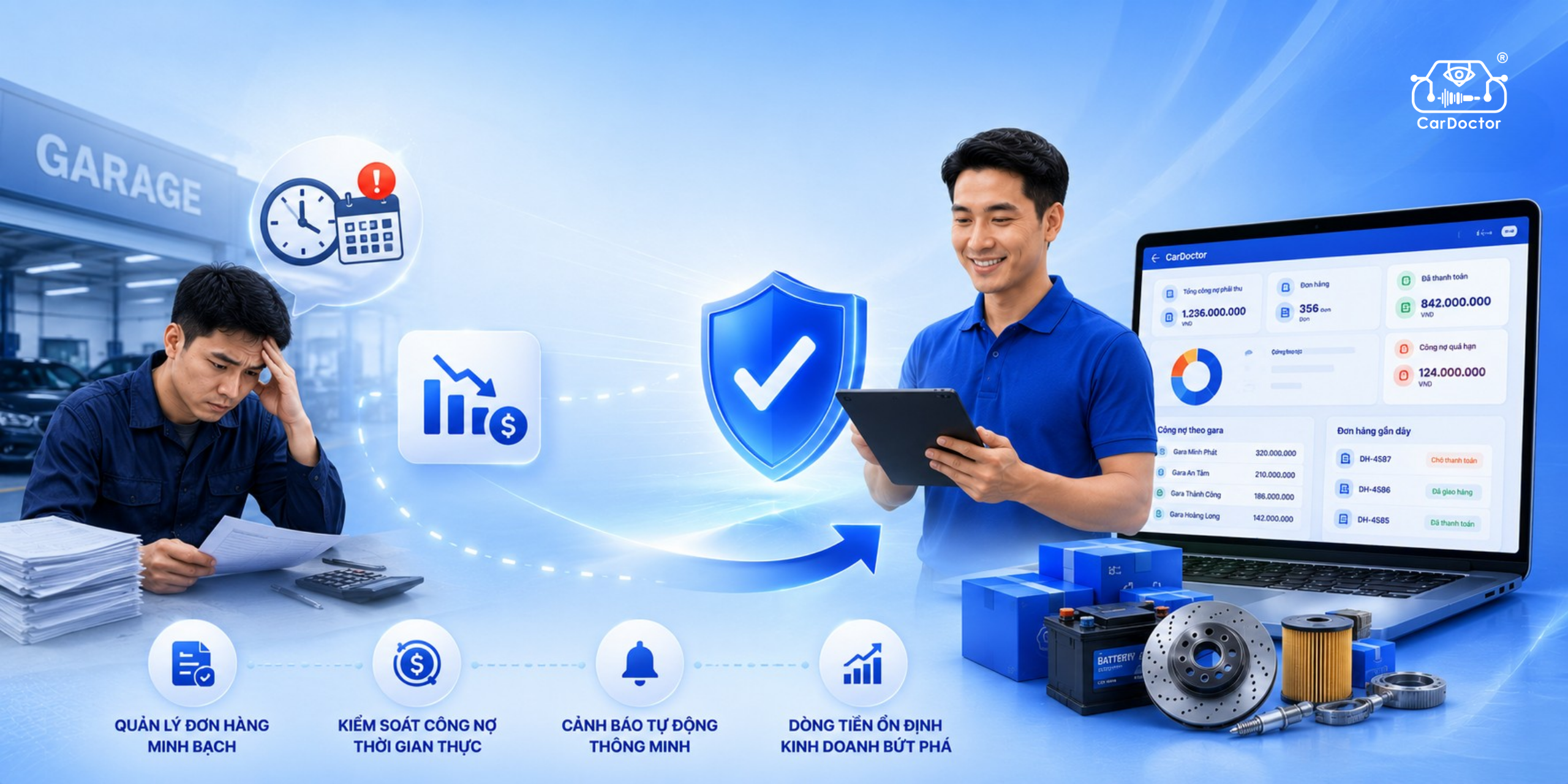
In the automotive spare parts business, closing an order successfully has never meant that the enterprise has actually realized its revenue. Only when cash flows back into the business account on time is the value of the order truly materialized. However, reality shows that accounts receivable remains one of the biggest bottlenecks for automotive parts suppliers in Vietnam.
Many businesses are falling into a vicious cycle: sales increase, yet cash flow grows increasingly tight. Goods continuously leave the warehouse, but receivables drag on day after day. In fact, some vendors have to spend months trying to collect payments for orders that were seemingly completed a long time ago.
When delayed payments from garages become a frequent occurrence, the issue no longer lies with a few isolated customers; rather, it reflects limitations in the enterprise’s management, operational, and receivables control methods.
So, what are the root causes behind vendors frequently facing delayed payments? And how can a business expand its reach while ensuring a steady, healthy cash flow? Let us explore in the article below.
1. Why do garages frequently delay payments?
In reality, delayed payments from garages do not always stem from an intentional effort to withhold capital. In many cases, the cause arises directly from manual management processes on both sides.
Receivables managed through disconnected tools
This is a common scenario among many spare parts businesses today.
Customer information is stored in Excel. Transaction histories are managed via Zalo or email. Orders are logged in internal ledgers. Meanwhile, accounting uses a separate software package to track receivables.
When a garage places multiple orders within a month, data reconciliation becomes extremely complex.
Sales representatives frequently find themselves dealing with questions such as:
- How much does this garage still owe?
- Which orders have been paid for?
- Which orders are approaching their due dates?
- What credit terms (number of days) apply to this customer?
- Have any product returns or exchanges occurred?
With just a single lack of data synchronization, the enterprise can lose significant time verifying the payment status of each order.
Vendors lack automated credit warning tools
A fairly common reality is that many businesses only discover overdue accounts when accountants conduct month-end reconciliations.
This means:
- Accounts receivable are already days past their due dates.
- Vendors miss the optimal window to send payment reminders.
- Cash flow is stalled without being addressed promptly.
If an enterprise serves hundreds of different garages, manually tracking receivables becomes virtually impossible.
Lacking real-time alerts means the enterprise remains constantly in a reactive state.
Lack of transparency in order fulfillment processes
One key reason payment timelines drag on is the excessive time spent by both parties re-confirming order details.
For example:
- The garage has not received the complete shipment.
- The garage needs to re-verify invoices.
- Returns or exchanges occurred for certain parts.
- Goods delivery and receipt histories require verification.
If all data is stored fragmentedly across multiple platforms, cross-referencing information alone can consume hours. This inadvertently slows down the entire payment workflow.
2. What consequences do delayed garage payments bring to vendors?
Many enterprises view accounts receivable merely as a financial issue. However, in reality, prolonged receivables directly undermine an enterprise’s competitive capacity.
Clogged cash flow
A business can achieve billions of VND in monthly revenue yet still face severe financial distress if receivables are not collected on time.
Sluggish cash flow circulation triggers a chain reaction of problems:
- Insufficient working capital to procure inventory.
- Inability to expand product catalogs.
- Delayed payments to supply partners.
- Mounting pressure on working capital requirements.
Particularly in the automotive parts sector, which involves a massive number of SKUs, a cash flow deficit can cause a business to miss critical opportunities during peak seasons.
Escalating operational expenses
As receivables stack up, the enterprise must allocate additional resources to:
- Reconcile data.
- Issue debt reminders.
- Handle complaints and disputes.
- Check transaction histories.
- Compile financial reports.
When staff spend hours every day dealing solely with receivables, operational costs increase significantly.
Hinderances to business scaling
When a business expands from serving dozens to hundreds of garages nationwide, managing receivables with Excel is no longer viable.
The larger the customer base, the higher the risk of data loss and delayed payments.
Enterprises then face a difficult dilemma:
- Expand business while taking on high credit risks, or
- Cap customer volume to keep management manageable.
Clearly, this is not a sustainable growth strategy in today’s increasingly competitive automotive parts market.
3. To end delayed payments, what must vendors change?
The first thing that needs changing is not credit policy, but the management mindset. Instead of dealing with receivables after problems arise, enterprises need to shift toward proactive management.
Bring transparency to the entire order fulfillment workflow
An efficient sales workflow requires all data to be synchronized onto a single platform:
- Requests for Quotation (RFQs).
- Orders.
- Delivery statuses.
- Incurred receivables.
- Payment histories.
- Invoices and related documents.
With all information centralized, the enterprise can easily:
- Verify order statuses.
- Confirm transaction histories.
- Track payment progress.
- Minimize potential disputes.
Transparency is the primary factor in shortening payment turnarounds between both parties.
Proactively monitor receivables in real time
Enterprises should not wait until month-end to perform receivables reconciliation.
A modern management system should enable vendors to:
- Track incurred receivables instantly.
- Identify which customers are approaching payment due dates.
- Receive automated alerts for overdue accounts.
- Aggregate receivables reports by individual garage.
Proactive monitoring helps businesses deploy timely resolution plans before minor debts turn into major problems.
Optimize the collaboration experience with garages
A garage tends to pay faster when the entire purchasing process is convenient and transparent.
This includes:
- Rapid quotations.
- Continuously updated order statuses.
- Fully archived transaction histories.
- Clear reconciliation processes.
- Complete visibility of payment information.
Operational professionalism not only enhances enterprise credibility but also helps accelerate debt recovery.
4. How CarDoctor Vendor Software helps vendors control receivables
Custom-developed for the automotive parts sector, CarDoctor Vendor Software is not just a sales management tool; it helps enterprises build a transparent operational workflow and optimize cash flow effectively.
Centralized order management on a single platform
From:
- Receiving RFQs,
- Processing orders,
- Tracking delivery statuses,
- Controlling receivables, to
- Reconciling payments— All are managed centrally on a single system.
This enables enterprises to:
- Minimize data errors.
- Save operational time.
- Prevent lost information.
- Elevate staff productivity.
Real-time receivables tracking
CarDoctor Vendor Software empowers enterprises to proactively manage:
- Total accounts receivable.
- Receivables broken down by customer.
- Payments approaching due dates.
- Overdue accounts requiring action.
- Detailed transaction histories per partner.
As a result, vendors can build proactive debt collection strategies instead of reacting defensively as before.
Transparent transaction history
Every transaction is fully logged on the system.
Enterprises can quickly look up:
- Which items a garage ordered.
- Order timestamps.
- Delivery status.
- Payment values.
- Previously completed transactions.
Centralized data storage not only prevents disputes but also builds long-term trust between vendors and customers.
Cash flow optimization for enterprises
When receivables are managed efficiently, enterprises gain tangible benefits:
- Accelerated debt collection speed.
- Optimized working capital.
- Proactive inventory procurement planning.
- Enhanced operational efficiency.
- Sustainable business scaling.
Furthermore, when connected to the CarDoctor ecosystem, vendors not only manage business operations more effectively but also gain opportunities to reach a nationwide network of garages.
5. It is time for vendors to transform receivables management
In an increasingly competitive automotive spare parts market, speed is no longer just an advantage—it has become a mandatory requirement.
An enterprise can spend vast amounts of time acquiring new customers, but if cash flow remains stalled for too long, all growth plans can be compromised.
If receivables were once viewed as an accounting chore, today they represent a core business management capability.
To end delayed payments from garages, vendors need more than just suitable policies; they need a system robust enough to:
- Bring transparency to the entire sales workflow.
- Proactively monitor receivables in real time.
- Optimize order processing speeds.
- Elevate the customer collaboration experience.
- Ensure cash flow remains steadily in circulation.
CarDoctor Vendor Software was developed with the mission of accompanying automotive parts suppliers on their digital transformation journey and comprehensive operational management.
Do not let prolonged receivables become a barrier to your enterprise’s growth. Start building a transparent, professional, and more efficient operational workflow today.
Follow CarDoctor to stay updated on the latest insights in automotive parts business management, automotive industry digitalization trends, and solutions to optimize operational efficiency for your business.