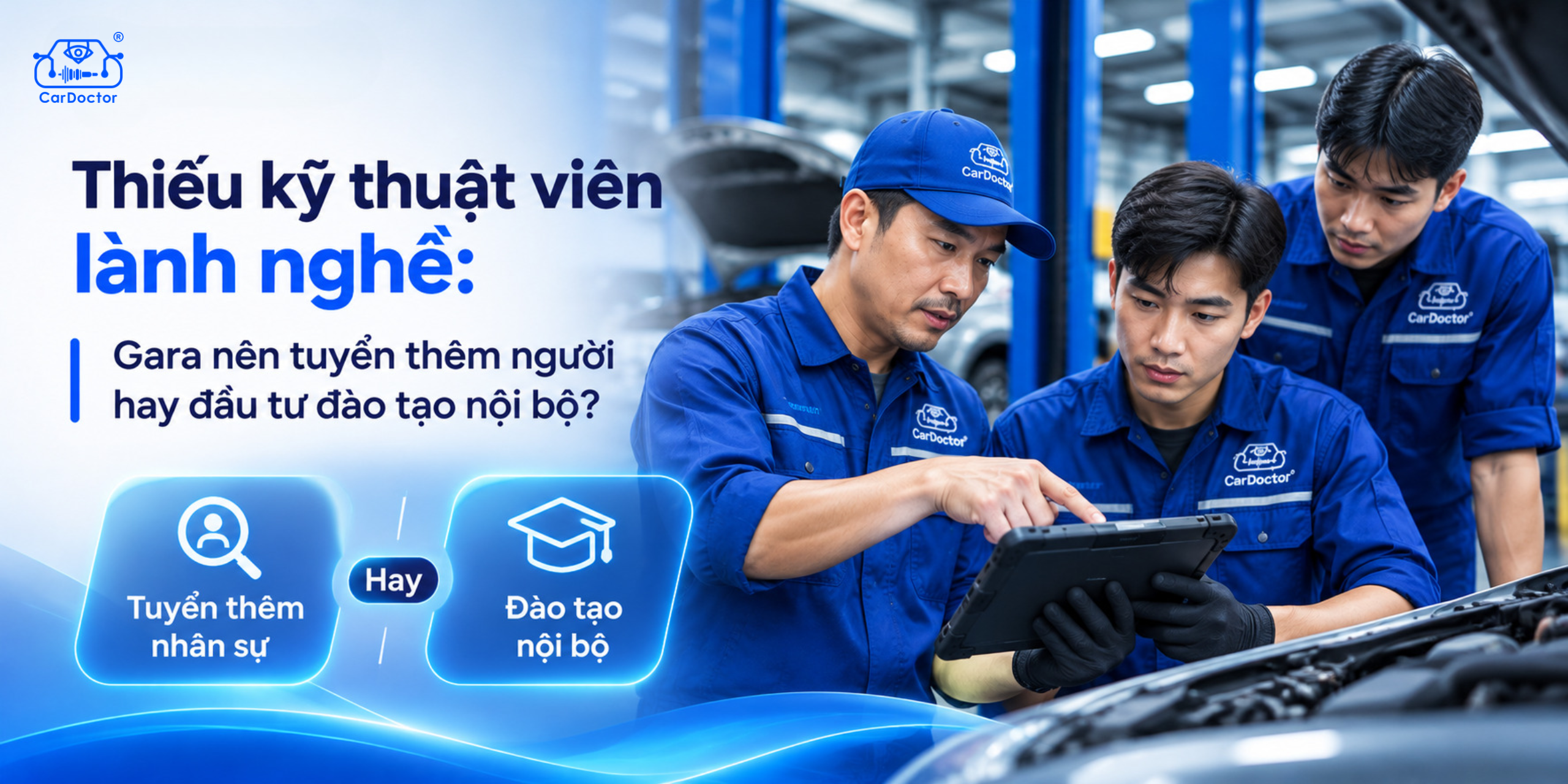
The shortage of skilled automotive technicians is becoming one of the major challenges facing auto repair garages in Vietnam. As vehicle technology becomes increasingly complex and repair services demand higher levels of expertise, finding technicians capable of working independently is far from easy. Under growing operational pressure, many garage owners face a critical decision: recruit experienced technicians at a higher cost or invest in developing their existing workforce? Which approach offers a more effective and sustainable human resources strategy?
1. Skilled technician shortages: A growing challenge for the automotive repair industry
As Vietnam’s automotive market continues to develop, increasing demand for vehicle maintenance, repair, and servicing is creating new requirements for businesses operating in the automotive aftermarket.
However, expanding workshop capacity is not simply a matter of installing additional vehicle lifts, purchasing diagnostic equipment, or increasing workshop space. The decisive factor in service delivery remains the technical workforce responsible for performing repairs.
According to an analysis published by VnEconomy Automotive in April 2026, Vietnam’s automotive industry faces limitations in its technical workforce, particularly the gap between formal education and practical skills.
Many graduates still require additional on-the-job experience before they can perform technical tasks independently.
This challenge is becoming increasingly significant as hybrid vehicles, electric vehicles, and advanced electronic systems become more common.
Today’s automotive technicians need more than expertise in conventional mechanical repairs. They must also understand diagnostic equipment, interpret technical data, identify the underlying causes of vehicle faults, and follow appropriate safety procedures.
For garage owners, a shortage of skilled personnel can lead to longer repair times, increased pressure on senior mechanics, and limited capacity to accept complex repair jobs.
This raises an important question: Should garages recruit experienced technicians from the labor market or proactively develop their workforce through in-house training?
2. Hiring experienced automotive technicians: A faster solution with its own challenges
When repair volumes increase or a garage lacks personnel capable of handling complex technical problems, recruiting experienced technicians is often the preferred solution.
The main advantage of this approach is the potential to strengthen technical capabilities relatively quickly.
After becoming familiar with the garage’s procedures, an experienced technician can undertake specialized repairs, support quality control, and reduce the workload of existing employees.
For garages expanding into automotive electrical systems, advanced diagnostics, or modern vehicle technologies, recruiting the right specialist can significantly shorten the time required to develop new technical capabilities.
Recruitment costs go beyond salaries
Hiring a skilled technician does not necessarily mean that a garage will immediately achieve a corresponding increase in productivity.
In addition to salaries, businesses must account for recruitment expenses, probation periods, onboarding, and the time required for new employees to become familiar with workshop equipment and operating procedures.
A technician with extensive experience at an authorized dealership service center may not necessarily be accustomed to working in a multi-brand independent garage, where different vehicle models and a wider variety of technical problems must be handled.
Furthermore, the market for highly skilled automotive professionals is competitive.
If garages rely exclusively on higher salaries to attract experienced personnel, they may face increasing labor costs without necessarily improving long-term workforce stability.
Therefore, recruiting experienced technicians is most appropriate when a garage has clearly defined technical requirements, sufficient financial resources, and an operational system capable of utilizing the recruit’s expertise effectively.
3. In-house training: A long-term investment in garage capabilities
Unlike external recruitment, in-house training focuses on developing the skills of existing employees or newly recruited entry-level technicians.
This approach allows businesses to gradually build a technical workforce aligned with their service portfolio and operational requirements.
A new technician may begin with basic maintenance tasks such as engine oil changes, tire inspections, brake system checks, or supporting activities.
Once these skills have been mastered, the employee can progress to more complex tasks under the supervision of experienced technicians.
Over time, garages can establish a structured career development pathway, progressing from workshop assistants and maintenance technicians to qualified repair technicians and diagnostic specialists.
Training helps standardize service quality
The benefits of in-house training extend beyond improving individual technical skills.
When technicians are trained according to consistent operating standards, garages can reduce differences in inspection methods, repair procedures, and vehicle handover practices.
This is particularly important for businesses planning to expand or develop multi-location automotive service networks.
Internationally, training models that combine formal instruction with practical experience are receiving increasing attention from automotive industry organizations.
In November 2026, the ASE Education Foundation in the United States announced a four-year, $25 million apprenticeship initiative designed to support the development of automotive, truck, and collision repair technicians.
This initiative illustrates how combining education with real-world workshop experience is being recognized as an important strategy for developing technical talent.
Nevertheless, in-house training also has limitations.
Garages must allocate time from senior technicians to mentoring activities, accept lower initial productivity from trainees, and carefully monitor the quality of work performed by inexperienced employees.
Without a clearly structured training program, learning may depend too heavily on individual mentors, resulting in inconsistent technical standards across the workforce.
4. Hiring or training: Which approach is more cost-effective?
To determine the most suitable strategy, garage owners need to evaluate workforce costs in relation to productivity and repair quality.
External recruitment generally involves higher personnel costs but may address specialized technical requirements more quickly.
In contrast, in-house training allows garages to develop employees according to their specific needs, although it requires time and resources.
The two approaches can be compared across several criteria:
| Criteria | Hiring experienced technicians | In-house training |
| Time to productivity | Generally faster when the right candidate is hired | Requires a longer development period |
| Initial costs | Recruitment and compensation expenses | Training and mentoring expenses |
| Operational adaptation | Requires familiarization with new procedures | Training follows established internal procedures |
| Specialized expertise | Can provide immediate technical capabilities | Developed progressively |
| Key risks | Poor hiring fit and employee turnover | Insufficient training outcomes and employee departure |
Neither approach is universally optimal for every garage.
If a workshop lacks personnel capable of diagnosing complex electrical or electronic faults, hiring an experienced specialist may be more effective than developing that expertise entirely from scratch.
Conversely, for routine maintenance and common repair tasks, developing younger technicians through structured training may provide better long-term value.
The key is to evaluate the total cost of developing or acquiring a productive technician, rather than comparing salaries or training expenses alone.
5. A combined approach: Recruiting core specialists while developing future talent
Rather than choosing exclusively between recruitment and training, garages can combine both approaches to create a balanced workforce structure.
Under this model, businesses prioritize recruiting a limited number of highly skilled technicians to handle complex work, supervise quality control, and mentor less experienced employees.
At the same time, garages recruit junior technicians or entry-level employees and develop their capabilities through structured training programs.
This approach helps reduce dependence on the external market for experienced technicians while creating a pipeline of future skilled employees.
Assigning responsibilities according to actual competency
For the combined approach to work effectively, garages need to define the responsibilities and technical limits of each employee category.
Workshop assistants can perform supporting activities and basic maintenance tasks under appropriate supervision.
Qualified repair technicians can handle tasks for which their competencies have been assessed and confirmed.
Senior technicians and specialists can focus on complex problems, system diagnostics, and repair quality assurance.
For work involving high-voltage electrical systems, braking components, or advanced driver assistance technologies, assignments must be based on verified technical qualifications and manufacturer guidelines.
The objective of this approach is not to make senior technicians responsible for completing all tasks on behalf of trainees.
Instead, it is to progressively transfer knowledge, develop independent working capabilities, and improve overall workshop productivity.
6. How can garages establish in-house training without disrupting daily operations?
A common challenge is that many garages want to train their employees but struggle to allocate sufficient time because daily repair operations must remain the priority.
To address this issue, owners should design training programs that are closely integrated with actual workshop activities.
The first step is to define the technical competencies required for each position, ranging from vehicle inspection, tool handling, and basic maintenance to advanced diagnostics and repairs.
Next, experienced technicians should be assigned mentoring responsibilities, supported by clear assessment criteria for individual skills.
Instead of organizing extensive training sessions that interrupt operations, garages can conduct shorter instructional activities focused on common faults, safe working practices, and standardized repair procedures.
For unfamiliar tasks, trainees should begin by observing experienced technicians, then progress to supervised practice.
Independent work should only be permitted after the employee has demonstrated the required competency.
Assessment results should be recorded so that workshop managers can determine which technicians are qualified to perform specific tasks.
Garages can also cooperate with vocational institutions, technical training centers, and equipment suppliers to provide specialized education and updated technical knowledge.
In April 2026, Hyundai Motor Group, the Korea International Cooperation Agency (KOICA), and Vietnam’s Ministry of Education and Training signed an agreement to support automotive technical workforce development.
The collaboration highlights the increasing importance of connecting technical education with the practical needs of automotive businesses.
7. Retaining skilled technicians: A challenge just as important as recruitment
Regardless of whether a garage prioritizes recruitment or training, it may continue experiencing workforce shortages if it fails to create a suitable working environment.
A well-trained technician may seek opportunities elsewhere if career progression is unclear or compensation does not reflect their contributions.
Therefore, a comprehensive workforce strategy must also include employee retention policies.
Beyond competitive salaries, garages should pay attention to working conditions, equipment availability, fair allocation of tasks, and opportunities to learn emerging automotive technologies.
Career development pathways should also be clearly communicated.
Technicians need to understand which competencies they must achieve to advance into higher positions and how their performance will be evaluated.
For highly skilled employees, opportunities to mentor junior colleagues, supervise technical operations, or develop repair procedures can provide additional motivation for professional growth.
A well-organized workplace with transparent advancement opportunities cannot guarantee that every employee will remain with the business indefinitely.
However, it can help reduce workforce instability and support stronger long-term employee engagement.
For garage owners, retaining experienced technicians also protects the business’s investment in training and preserves valuable technical knowledge.
8. Conclusion: Garages need a workforce development strategy, not just a hiring solution
The shortage of skilled automotive technicians is not merely a recruitment issue.
It also reflects broader challenges involving technical education, work organization, and human resources management within the automotive repair industry.
Hiring experienced technicians can help garages strengthen specialized technical capabilities relatively quickly.
Meanwhile, in-house training provides a foundation for long-term workforce development and supports consistent service quality.
For many garages, the most suitable strategy is to combine the recruitment of core technical specialists with the development of junior employees, taking into account actual business needs and financial resources.
As automotive technology continues to evolve rapidly, sustainable competitive advantage will depend not only on how many technicians a garage employs, but also on its ability to train, utilize, and continuously develop the capabilities of each team member.
Garages that proactively establish workforce development strategies today will be better positioned to improve productivity, maintain repair quality, and adapt to the ongoing transformation of Vietnam’s automotive aftermarket.