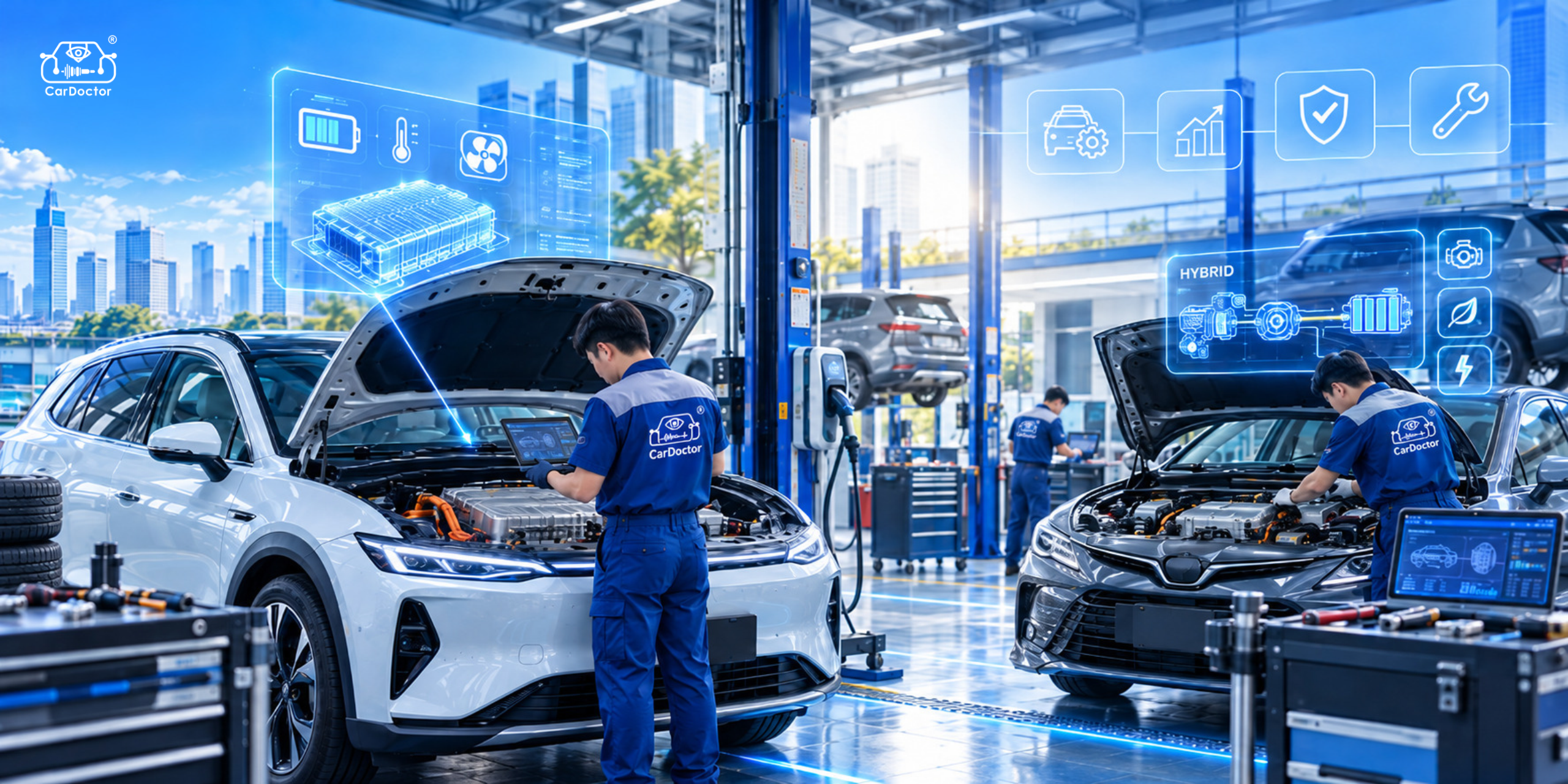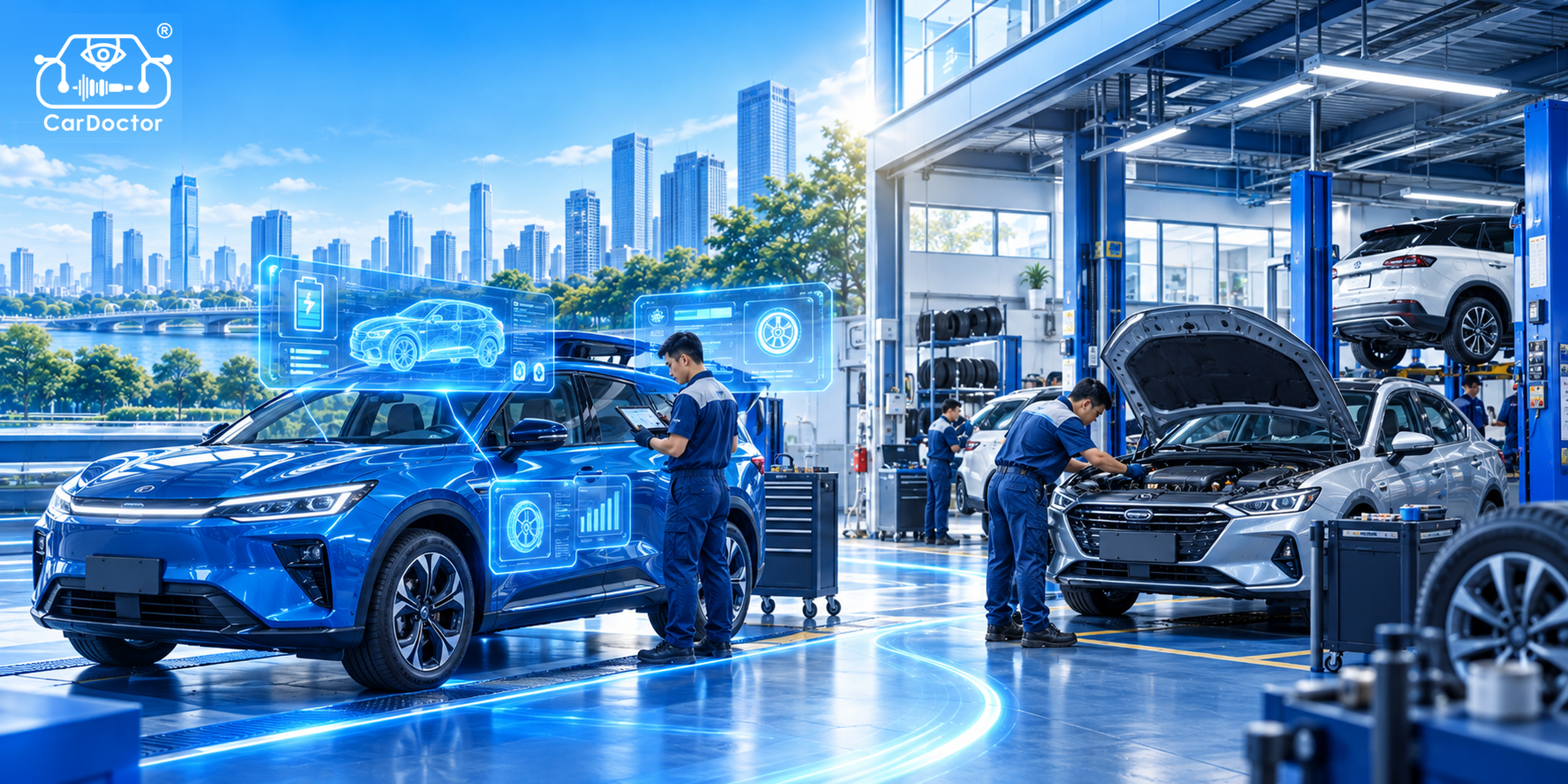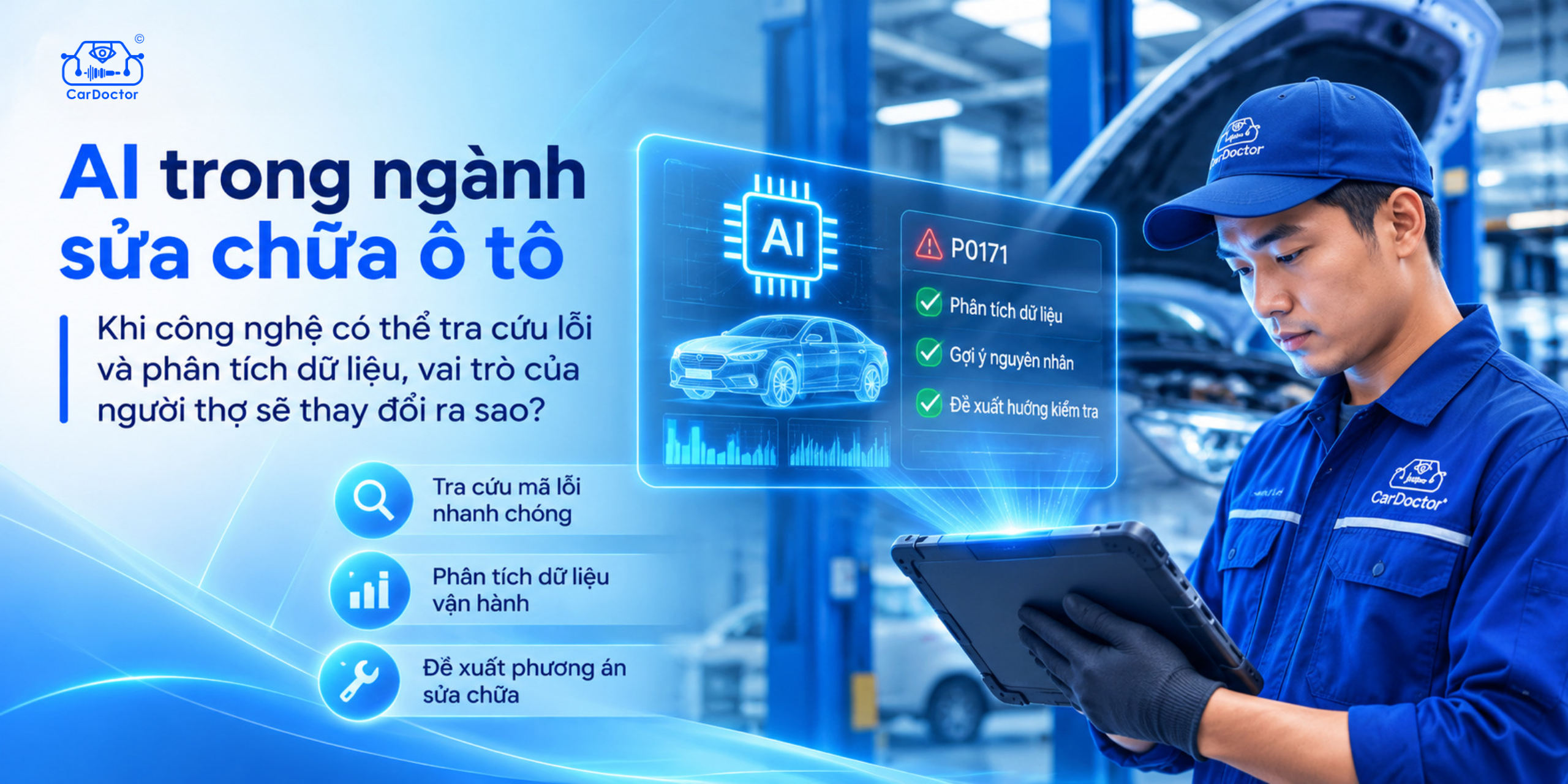
Artificial intelligence (AI) is gradually transforming the way automotive repair garages approach vehicle diagnostics and maintenance. From assisting with diagnostic trouble code lookups and analyzing operational data to suggesting potential solutions, AI offers opportunities to shorten diagnostic times and improve workshop efficiency. However, as technology becomes increasingly intelligent, will the experience of automotive mechanics remain a decisive factor? And how should repair garages prepare to adopt AI effectively without becoming overly dependent on it?
1. When AI begins to play a role in automotive diagnostics and repair
For many years, automotive fault diagnosis has depended primarily on the practical experience of technicians, supported by testing equipment and technical repair documentation.
When a vehicle develops unusual symptoms such as engine vibration, increased fuel consumption, or an illuminated warning light, mechanics must inspect the symptoms, retrieve diagnostic trouble codes, compare technical specifications, and systematically eliminate possible causes.
This process requires both technical knowledge and analytical skills. For complex faults, identifying the actual root cause can take considerable time.
The emergence of AI is beginning to change how technicians approach these tasks.
Instead of manually searching through multiple technical documents, technicians can use specialized AI-powered systems to retrieve information, consolidate data, and obtain suggestions for appropriate inspection procedures.
Notably, at Automechanika Frankfurt 2026, Bosch introduced an AI assistant integrated into its ESI[tronic] diagnostic software. According to Bosch, the system can analyze diagnostic data and reference repair instructions and original manufacturer documentation to recommend potential solutions. The technology also received an innovation award at the exhibition in the AI Solutions & Digitalisation category.
This development demonstrates that AI is no longer limited to office productivity applications. It is gradually becoming part of the equipment and software ecosystem supporting automotive workshops.
However, the ability to recommend repair procedures does not mean that AI can accurately identify every fault or completely replace the work of professional technicians.
2. What tasks can AI help automotive mechanics perform?
The application of AI in automotive repair extends beyond explaining diagnostic trouble codes. When integrated with suitable technical databases and diagnostic systems, the technology can support several stages of the repair process.
Looking up diagnostic trouble codes and technical documentation
One of the most practical applications is information retrieval.
In modern vehicles, electronic systems can generate numerous diagnostic trouble codes (DTCs) related to engines, transmissions, braking systems, sensors, or communication networks between electronic control units.
Instead of searching for each fault code separately across multiple sources, technicians can use AI to summarize its meaning, identify relevant technical information, and determine which components or systems should be inspected.
For example, when a vehicle displays diagnostic trouble code P0171, indicating a system-too-lean condition on Bank 1, AI can help identify potential causes, such as intake air leaks, inaccurate sensor readings, or fuel delivery problems.
However, a diagnostic trouble code does not independently confirm which component has failed. Technicians must still conduct physical inspections and tests to identify the actual cause.
Analyzing vehicle operational data
Beyond fault codes, AI systems integrated with appropriate data sources can assist in analyzing operational parameters such as temperature, pressure, sensor signals, and changes in data over time.
Comparing multiple parameters may help identify abnormal patterns that are difficult to recognize when examining individual readings.
TEXA, an automotive diagnostic equipment provider, has introduced AI Global Search and AI Smart Diagnosis features within its IDC6 platform. These capabilities are designed to support information retrieval and diagnostic recommendations using technical data, fault codes, and stored repair cases.
For automotive garages, such tools can reduce the time spent searching for information and help technicians develop more systematic diagnostic procedures.
Supporting repair planning and decision-making
After analyzing available information, AI can assist in recommending inspection sequences, identifying relevant technical documentation, or comparing possible repair approaches.
Nevertheless, AI-generated results should be regarded as decision-support information rather than definitive repair instructions.
The final repair strategy must still be validated through actual vehicle data, manufacturer guidelines, and professional technical assessment.
3. AI can analyze data, but it cannot fully replace hands-on experience
A fundamental difference between AI and professional automotive technicians lies in the ability to physically verify a vehicle’s condition.
AI can process the information it receives, but it does not automatically have access to every factor contributing to a malfunction.
For example, a vehicle experiencing unusual vibrations during acceleration may have problems related to the engine, drivetrain, engine mounts, or several other components.
If the available data is incomplete, AI may generate reasonable hypotheses that do not accurately reflect the vehicle’s actual condition.
Experienced technicians, on the other hand, can combine multiple sources of evidence, including sounds, vibrations, operating conditions, service history, measurement results, and abnormalities discovered during physical inspections.
For intermittent faults or problems involving multiple interconnected systems, the mechanic’s ability to reason through potential causes and verify them remains essential.
In 2024, the National Institute for Automotive Service Excellence (ASE) announced a research partnership exploring evaluation standards for AI in automotive diagnostics and repair.
The initiative highlighted several important considerations, including accuracy, transparency, verifiability, and accountability for AI-generated recommendations.
This reflects an essential principle: AI may help technicians identify potential solutions more quickly, but repair decisions must still be based on verified diagnostic results and sound technical judgment.
4. The mechanic’s role is shifting from performing tasks to analyzing information and making decisions
As AI becomes more integrated into automotive diagnostics, the role of technicians is also expected to evolve.
Traditionally, a substantial portion of diagnostic work could involve searching for documentation, comparing fault codes, and identifying possible testing procedures.
With technological assistance, these activities may become faster and more efficient.
Technicians can consequently devote more time to validating diagnostic hypotheses, resolving technical problems, and evaluating repair quality.
This transformation can be understood through three important changes.
First, mechanics need to evaluate information rather than simply receive it.
An AI-generated recommendation must be assessed within the context of the specific vehicle model, its operating conditions, and actual measurement results.
Second, system-level analytical capabilities are becoming increasingly important.
As mechanical components, electronics, and software become more interconnected, technicians must understand how these systems interact to identify the underlying causes of failures.
Third, responsibility for repair quality remains with human professionals.
AI can provide recommendations, but it cannot replace the responsibility of ensuring that a vehicle meets the necessary technical and safety requirements before being returned to its owner.
Therefore, technology does not simply diminish the importance of automotive mechanics.
Instead, it may raise expectations regarding the technical expertise, analytical capabilities, and decision-making skills required of modern technicians.
5. The risks of becoming overly dependent on AI in automotive workshops
Despite its potential benefits, implementing AI without adequate oversight can introduce technical and operational risks.
One significant limitation is that AI systems may generate inaccurate or unsupported information.
Generative AI tools can produce highly convincing responses even when the underlying information is incomplete.
If technicians treat these responses as official repair instructions, they may increase the risk of misdiagnosis or unnecessary component replacement.
Furthermore, the quality of AI-generated insights depends heavily on the information provided.
Outdated technical documentation, inaccurate sensor data, or information that does not match the specific vehicle version can all affect diagnostic results.
Another important issue involves access to manufacturer data.
According to research published by the European Commission in 2026, independent automotive repair businesses in Europe continue to encounter limitations in accessing advanced diagnostic data, software, and vehicle operating information.
This provides an example of how AI technology alone cannot resolve every diagnostic challenge without reliable and appropriate data sources.
For automotive garages, an essential principle is that an AI-generated response should never serve as the sole justification for replacing components or performing safety-critical procedures.
In particular, work involving braking systems, steering systems, Advanced Driver Assistance Systems (ADAS), and high-voltage electrical systems must comply with manufacturer instructions and specialized technical procedures.
AI should support professional judgment, not replace established safety practices.
6. What skills should Vietnamese automotive garages develop among their technicians?
As AI gradually becomes part of automotive repair solutions, workforce training should become an important priority for garages.
However, the objective is not to turn every automotive technician into a programmer or AI developer.
Instead, training should focus on capabilities directly relevant to vehicle diagnostics and repair.
The first priority is knowledge of automotive electrical and electronic diagnostics.
Technicians need to understand how sensors, electronic control units, communication networks, and related systems operate.
The second priority is data analysis and interpretation.
Mechanics should be able to operate diagnostic equipment, interpret real-time vehicle data, compare technical parameters, and recognize abnormal patterns.
The third priority is the responsible use of AI tools.
Technicians should know how to formulate clear questions, provide accurate vehicle information, verify source documentation, and assess the relevance of AI-generated recommendations.
The fourth priority is communication with customers.
As automotive repairs become increasingly technology-driven, technicians and service advisors must be capable of explaining technical problems, proposed solutions, and associated costs in clear, accessible language.
This capability helps translate complex diagnostic findings into transparent and trustworthy customer service experiences.
By strengthening these competencies, garages can help their teams take advantage of new technologies without compromising professional standards.
7. Where should garage owners begin when implementing AI?
For small and medium-sized automotive garages, adopting AI does not necessarily require investing immediately in complex data analytics platforms or expensive equipment.
A more practical starting point is identifying activities that consume significant time and can benefit from appropriate technological support.
In the initial stage, garages can experiment with AI to assist in retrieving technical information, summarizing repair histories, developing training materials, or helping service reception staff explain basic automotive terminology.
Once a more structured data management system is established, businesses can explore AI applications for analyzing repair durations, identifying recurring faults, managing spare parts, and supporting operational planning.
For direct vehicle diagnostics, garages should prioritize specialized solutions supported by reliable technical data and compatible with the vehicle models they regularly service.
Implementation should also be evaluated using measurable performance indicators, such as average diagnostic time, repeat repair rates, labor hours saved, and customer satisfaction levels.
These metrics can help garage owners determine whether AI is delivering genuine operational benefits rather than investing in technology simply because it has become a popular trend.
Ultimately, the goal should be to use AI where it contributes measurable value while maintaining appropriate human supervision and technical accountability.
8. Conclusion: AI will not replace skilled mechanics, but it will redefine what makes a mechanic skilled
The development of artificial intelligence is opening a new chapter for the automotive repair industry, where data and technology play increasingly important roles.
AI can help reduce information retrieval time, analyze technical data, and recommend diagnostic approaches.
However, the technology still faces limitations related to data availability, verification, and the assessment of real-world vehicle conditions.
Meanwhile, human technicians remain central to identifying root causes, selecting repair solutions, and ensuring technical quality.
Perhaps the most significant transformation will not be determined by how many tasks machines can perform instead of people, but by how effectively mechanics use technology to enhance their professional capabilities.
In the future, a garage’s competitive advantage will depend not only on having experienced technicians but also on its ability to combine that experience with operational data, modern diagnostic tools, and AI in an effective and responsible manner.
For automotive garages in Vietnam, proactively strengthening technological capabilities and investing in workforce development today will be essential steps toward adapting to the ongoing transformation of the automotive aftermarket.